Budgeting Without Burnout: How to Build a System You Can Actually Maintain
Learn how to create a budgeting system that stays practical, realistic, and sustainable without becoming mentally exhausting over time.
For many people, budgeting does not fail because the numbers are wrong. It fails because the process gradually becomes exhausting.
At the beginning, financial organisation often feels motivating. A new spreadsheet is created, categories are carefully defined, spending is reviewed more closely, and there is usually a clear sense that this time the system will finally create control. The first days often feel productive because every financial decision appears more visible than before.
But after several weeks, the emotional experience often changes.
Updating categories begins to feel repetitive. Reviewing purchases after long days feels inconvenient. Small deviations from the plan start creating frustration. The budget, which initially felt like a useful tool, slowly begins to resemble another obligation competing for time and attention.
This is one of the most common reasons people stop budgeting even when they still care deeply about improving their finances. The issue is rarely lack of discipline. More often, the system itself demands more mental energy than daily life can comfortably support.
A sustainable budget must therefore do more than organise money. It must also fit the rhythm of ordinary life.
Why Financial Systems Often Become Mentally Heavy
Budgeting is usually introduced as a technical process: income enters, expenses are categorised, limits are assigned, and monthly outcomes are reviewed.
In reality, budgeting also carries emotional weight because every number reflects daily decisions, priorities, trade-offs, and sometimes difficult realities that people would rather not confront constantly.
When every purchase requires reflection, every category feels strict, and every review highlights where expectations did not match reality, budgeting can begin to feel emotionally heavier than expected.
This is especially true when the system is too detailed from the beginning.
A person may create many categories, subcategories, colour codes, and tracking rules because precision feels responsible. But the more effort a budget requires every day, the more likely it becomes that consistency weakens when life becomes busy.
The problem is not detail itself. The problem is when the maintenance cost of the system becomes higher than the benefit it provides.
A Good Budget Should Reduce Mental Noise, Not Create More of It
One of the strongest signs that a budget is becoming unsustainable is when thinking about it starts creating resistance.
This usually happens quietly.
A few days pass without updating expenses. Then a week. Small purchases are mentally postponed because categorising them feels inconvenient. Eventually opening the budget feels slightly uncomfortable because catching up requires effort.
At that stage, many people believe they failed.
In reality, the system often became too heavy for ordinary use.
A practical budget should lower mental pressure by making money easier to understand, not harder to face.
This usually means reducing unnecessary friction. Categories should remain clear but not excessive. Reviews should happen regularly but not obsessively. Small spending differences should be visible without being treated like mistakes.
The goal is not constant control. The goal is steady clarity.
Simpler Systems Usually Survive Longer
A common misconception is that stronger financial discipline always requires stronger complexity.
Yet many long-term budgeting systems that actually survive are surprisingly simple.
Instead of tracking every minor category separately, people often maintain broader groups that still reveal useful patterns. Instead of reviewing spending daily with strict corrections, they review weekly or monthly with calm adjustments.
This simplicity matters because life rarely provides equal mental energy every day.
There are busy periods, stressful weeks, family obligations, work pressure, travel, and ordinary days when financial administration simply cannot sit at the centre of attention.
A budget that only works under ideal conditions usually stops working quickly.
A simpler budget often performs better because it remains usable during ordinary life, not only during motivated periods.
Burnout Often Comes From Treating Every Month as a Test
Another major reason budgeting becomes tiring is the belief that each month must prove success.
When people view monthly budgeting as something that can be passed or failed, emotional pressure rises quickly.
If one category exceeds expectations, the month begins to feel damaged. If savings are lower than planned, progress feels interrupted. If unexpected expenses appear, frustration often replaces perspective.
But real financial life rarely behaves in perfectly controlled monthly cycles.
Some months naturally cost more.
A family event, health cost, seasonal expense, repair, travel need, or simple daily variation can change spending without indicating that the system itself is failing.
Budgets become healthier when months are treated as information rather than judgment.
The purpose of each month is not perfection. It is understanding.
Flexibility Is a Financial Strength, Not a Weakness
Many people worry that allowing flexibility means losing discipline.
In practice, flexibility often creates stronger consistency.
If one category needs more space, another may temporarily need less. If spending patterns change for a period, the budget should reflect that rather than resist it rigidly.
This does not weaken the system. It makes it realistic.
The strongest budgets usually contain structure without rigidity. They provide guidance while accepting that life changes month to month.
This is especially important for households, parents, variable work schedules, seasonal costs, and anyone whose spending naturally shifts over time.
A budget that allows movement often survives much longer than one built around fixed ideal numbers.
Financial Habits Improve More Through Repetition Than Intensity
Many people begin budgeting with strong intensity because they want visible improvement quickly.
This often includes aggressive savings targets, detailed tracking, strict category limits, and constant checking.
The problem is that intensity often fades faster than expected.
What remains after that initial energy matters far more.
This is why repetition usually matters more than strictness. A budget reviewed calmly every month for a year creates far more financial progress than a highly ambitious system abandoned after six weeks.
Small consistent habits usually outperform short periods of financial intensity.
This is true not only in saving, but also in awareness itself.
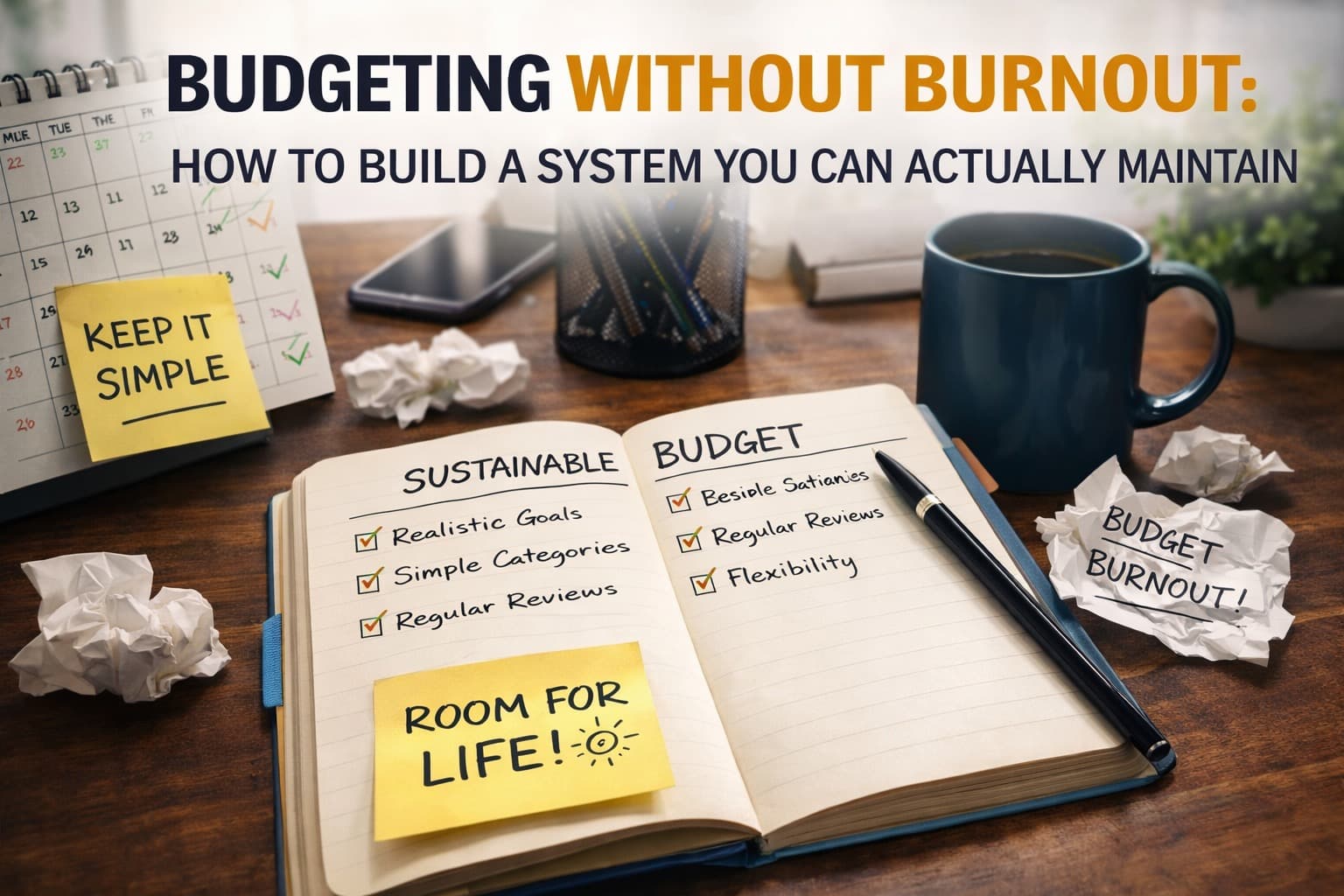
A Sustainable Budget Should Leave Room for Life
Perhaps the most important principle in avoiding budgeting burnout is remembering that money exists inside life, not outside it.
A financial system should support decisions, reduce uncertainty, and help create direction. It should not feel like a permanent source of tension.
This means that normal spending should not immediately feel suspicious. It means occasional irregular costs should not destroy confidence. It means reviewing finances should feel informative rather than emotionally heavy.
When budgeting starts supporting ordinary life instead of competing with it, long-term consistency becomes much more natural.
That is where budgeting stops being a temporary effort and becomes a stable habit.
Final Thoughts
Budgeting without burnout is not about caring less about money. It is about building a system that respects how people actually live. The strongest financial systems usually look less strict than expected. They are simpler, calmer, and more flexible than many first budgets people try to build. A budget becomes sustainable when it remains usable even during imperfect months. That is what allows financial habits to last.
Long-term budgeting usually works better when the system is simple enough to survive ordinary months. If some categories already feel emotionally exhausting, Why Tracking Every Expense Is Not Always the Best Budgeting Strategy explains why over-monitoring can sometimes weaken consistency. If your budget recently stopped working altogether, How to Reset a Budget After a Bad Month Without Starting Over offers a more realistic way forward.