Why Tracking Every Expense Is Not Always the Best Budgeting Strategy
Learn why tracking every expense often makes budgeting harder to maintain and discover a simpler budgeting approach that works long term.
For many people, budgeting begins with the belief that every expense must be recorded in order for money management to improve. It feels like the responsible place to start. If every purchase is visible, then every financial decision should theoretically become easier to understand. A coffee bought on the way to work, an online subscription renewed automatically, a grocery receipt, a pharmacy purchase, or a small household expense all begin to feel important because they now belong inside a larger effort to gain control.
In the beginning, this level of attention often creates genuine momentum. For the first time, spending stops feeling abstract. Numbers begin to replace assumptions, and many people experience an immediate sense of financial awareness simply because money is being observed more carefully than before. The difficulty usually appears later, when the system that felt useful starts requiring more energy than expected.
Tracking is useful, but only when it supports clarity rather than pressure. If budgeting already feels mentally heavy, Budgeting Without Burnout: How to Build a System You Can Actually Maintain explains how to reduce unnecessary friction. If recent months have already disrupted your plan, How to Reset a Budget After a Bad Month Without Starting Over helps rebuild stability without abandoning the entire system.
Detailed Tracking Often Creates More Friction Than Clarity
A budgeting method built around recording every transaction can quickly become mentally heavy, especially when daily life becomes busy.
The effort itself is usually underestimated at the start. Recording spending sounds simple when motivation is high, but ordinary life rarely remains equally structured every day. Work becomes demanding, family responsibilities increase, routines shift, and small financial decisions happen quickly without the time or desire to document each one immediately.
What often happens is not a sudden rejection of budgeting, but a gradual weakening of consistency. A few purchases are left unrecorded because there is no time. Then several days pass. Then reviewing the budget begins to feel uncomfortable because catching up now requires effort.
At that point, budgeting starts feeling like unfinished administrative work rather than a helpful system.
This is one of the most common reasons highly motivated people quietly stop using otherwise well-designed budgets.
Not Every Expense Carries Equal Financial Weight
Another important limitation of tracking every expense is that not all spending influences financial outcomes in the same way.
Small daily purchases are visible and easy to focus on because they happen often. They create the impression that financial discipline depends on controlling every minor decision.
In reality, long-term financial pressure usually comes from larger recurring structures.
Housing costs, transportation, debt repayments, recurring subscriptions, insurance, school-related expenses, family obligations, and savings habits usually determine far more than occasional small purchases. A person may record every coffee precisely while never fully confronting the fact that fixed monthly commitments already consume too much of available income.
This is why perfect tracking does not automatically produce better financial decisions.
Without broader financial interpretation, detail alone often creates activity without real improvement.
Broad Categories Often Reveal More Than Perfect Transaction Logging
For many households, budgeting becomes more useful when expenses are understood in broader categories rather than individual isolated entries.
A category-based view immediately creates stronger perspective because patterns become easier to interpret.
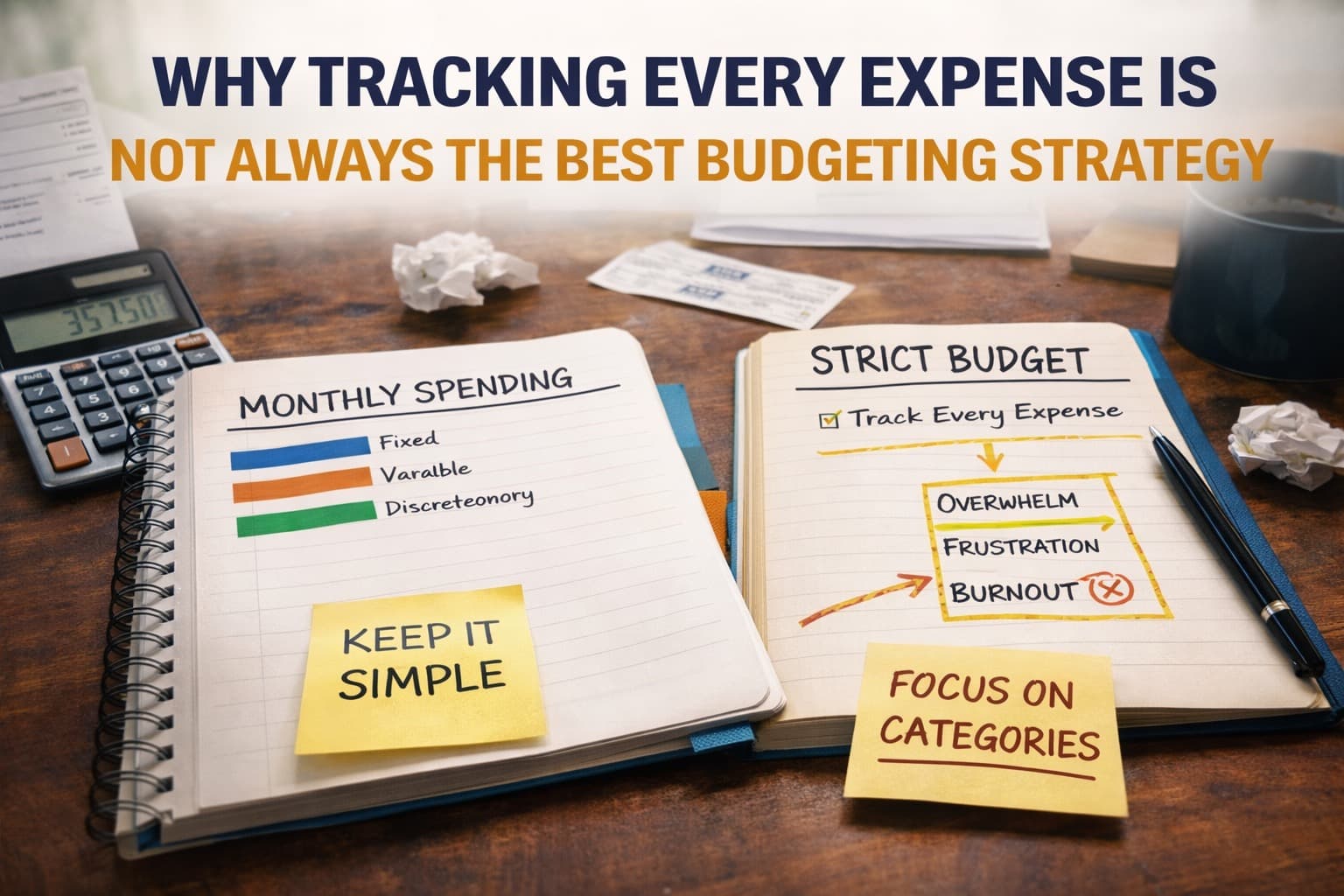
Fixed obligations show how much of the month is already financially committed before daily spending begins. Variable essentials reveal how groceries, transport, and ordinary living costs behave over time. Discretionary categories show where flexibility exists without forcing constant self-correction.
This broader structure usually makes budgeting feel calmer.
A grocery category, for example, often teaches more over several months than daily item-level logging. The same is true for entertainment, transport, and personal spending. The goal is not to understand every receipt individually forever. The goal is to understand whether categories behave realistically over time.
That difference often determines whether budgeting remains practical.
Constant Financial Recording Can Quietly Create Emotional Fatigue
One reason strict expense tracking often becomes unsustainable is that it changes how everyday spending feels psychologically.
When every purchase must be documented, ordinary decisions begin carrying more emotional weight than they naturally should. A small unplanned expense no longer feels neutral because it immediately becomes part of something that must later be reviewed.
Over time, this can create subtle resistance.
Budgeting begins to feel associated with correction, catching up, and noticing where expectations were not met. Even when spending itself remains normal, the process can feel tiring because every decision appears under constant observation.
A healthy budget should create awareness without making ordinary spending feel emotionally heavy.
That balance is often easier to achieve when review happens periodically rather than continuously.
Weekly Review Often Works Better Than Daily Control
For many people, weekly review creates stronger long-term budgeting habits than daily transaction tracking.
A weekly rhythm offers enough visibility to understand spending patterns while reducing the pressure of constant financial attention.
Instead of interrupting every day, spending can be reviewed in larger context. A week immediately shows whether categories remain balanced, whether irregular costs appeared, and whether certain spending areas need adjustment before the month continues.
This also helps remove unnecessary emotional reaction to individual purchases.
One single day rarely explains much financially. A week usually explains far more.
That perspective makes budgeting feel less fragile and more realistic.
Technology Has Changed the Role of Manual Tracking
Many financial tools now automatically categorize spending through bank integrations, apps, and account summaries.
Because of this, the role of budgeting has shifted.
The challenge today is less about collecting every number manually and more about deciding what those numbers mean in practical life. Most people already have access to transaction history. What often remains difficult is building a financial structure that does not require constant intervention.
This is why manual precision alone is no longer the strongest advantage.
Interpretation matters more than raw tracking.
A budget should answer practical questions clearly:
- Are fixed costs too high?
- Are variable categories realistic?
- Is savings happening consistently?
- Are recurring patterns improving?
These answers matter more than perfect transaction history.
The Strongest Budget Is Usually the One That Survives Ordinary Months
The most effective budgeting systems are rarely the most detailed.
They are usually the systems that remain usable during normal life — not only during highly motivated periods.
A budget that requires ideal discipline every day often weakens quickly because normal months are rarely ideal. There are busy periods, unexpected costs, emotional spending moments, seasonal changes, and simple weeks when financial attention naturally drops.
A system that allows for that reality usually lasts longer.
Tracking every expense can be valuable at the beginning, especially when spending habits are still unclear. But once patterns become visible, many people improve faster by simplifying rather than adding more detail. Long-term financial stability usually comes from repeatable habits, not permanent intensity. That is why clarity often matters more than perfection.