Why Most Budgets Fail (And How to Build One That Sticks)
Most budgets fail for predictable reasons. Learn why—and how to build a realistic budget you'll actually stick to long term.
If you've tried budgeting before and quit, you're not bad with money. You're normal.
Most budgets fail not because people don't care-but because the system they're using was never designed for real life. It assumes perfect discipline, stable expenses, and zero emotions. None of those things exist.
Let's break down why budgets usually fail, and then walk through how to build one that actually survives real months, real stress, and real people.
The uncomfortable truth about budgeting
A budget is not a spreadsheet problem. It's a behavior problem.
You can know exactly what you should do and still not do it. That's not laziness-it's human nature.
Budgets fail when they:
- Ignore how people actually spend
- Rely on constant willpower
- Punish small mistakes
- Demand perfection from day one
A budget that works is one you can keep running even when you're tired, busy, stressed, or distracted.
Reason #1: The budget is built on fantasy numbers
This is the most common failure point.
People often create budgets based on:
- What they want to spend
- What they think they should spend
- What an online template says is "ideal"
Instead of what they actually spend.
Example:
You've been spending €600/month on groceries. Your new budget says €400. That budget didn't fail. It was never realistic.
How to fix it
Start building a realistic monthly budget by relying on:
- Look at the last 30–60 days
- Use those averages as your starting point
- Improve gradually (5–15% at a time)
A budget that starts at reality can evolve. One that starts in denial collapses.
Reason #2: There's no room for life to happen
Budgets often break the moment something unexpected shows up:
- Car repair
- Medical bill
- School expense
- Gift you forgot about
- Travel you didn't plan perfectly
When there's no buffer, one surprise makes the whole budget feel useless.
How to fix it
Add shock absorbers:
- A buffer category
- Sinking funds for predictable "surprises"
- A small emergency fund
Irregular expenses are not accidents. They are part of life. Budgeting as if they won't happen guarantees failure.
Reason #3: The budget tries to change everything at once
A classic mistake: "This month we'll stop eating out, cut shopping, save more, pay off debt, and be perfect."
That's not a plan. That's burnout scheduled for week two.
How to fix it
Change one or two things per month:
- One category to reduce
- One habit to improve
- One clear priority
Progress compounds. Overwhelm kills consistency.
Reason #4: The budget feels like punishment
If your budget feels like:
- "No fun allowed"
- "Constant guilt"
- "Everything is restricted"
You'll rebel against it. Hard.
How to fix it
Budget for enjoyment:
- A small "fun" category
- Personal spending for each partner
- Guilt-free money that doesn't require justification
A budget that includes enjoyment is sustainable. A joyless budget isn't.
Reason #5: Tracking is too detailed (or too demanding)
Some people quit budgeting because it turns into unpaid accounting work. For it to succeed you need to establish some expense tracking habits.
If every coffee, snack, and parking ticket must be logged instantly, fatigue sets in fast.
How to fix it
Simplify tracking:
- Fewer categories
- Weekly check-ins instead of daily micromanagement
- Focus on totals, not perfection
A budget is a steering wheel, not a microscope.
Reason #6: Income variability isn't respected
If your income changes month to month and your budget assumes stability, stress is guaranteed.
Good months create false confidence. Bad months create panic.
How to fix it
Budget from a conservative baseline:
- Lowest recent month
- Or average minus 10-15%
Extra income becomes:
- Savings
- Debt payoff
- Buffer expansion
This stabilizes your finances emotionally-not just mathematically.
Reason #7: Partners aren't aligned
In family or couple budgets, this one is huge.
If:
- One person tracks
- One person spends
- Or expectations aren't clear
The budget becomes a source of conflict instead of clarity.
How to fix it
- Agree on shared goals
- Create shared categories
- Give each person personal spending money
- Review the budget together monthly (briefly)
Budgets fail when they're imposed. They work when they're agreed on.
How to build a budget you'll actually stick to
Now let's flip the script. Here's what working budgets have in common.
1. They start from reality, not ideals
- Real spending history
- Real income
- Real obligations
Then they improve slowly.
2. They focus on systems, not motivation
You won't feel motivated every month. A good budget assumes that-and works anyway.
- Automatic savings
- Fixed review times
- Simple rules for overspending
3. They include flexibility
Flexibility is not weakness. It's resilience.
- Move money between categories
- Adjust month to month
- Learn instead of quitting
4. They define rules for "failure" in advance
Overspending will happen.
Decide now:
- Where money comes from
- What happens next week
- How to adjust next month
This removes guilt and replaces it with structure.
5. They get easier over time
If your budget feels harder every month, something is wrong.
A good budget:
- Requires less effort over time
- Builds predictability
- Reduces decision fatigue
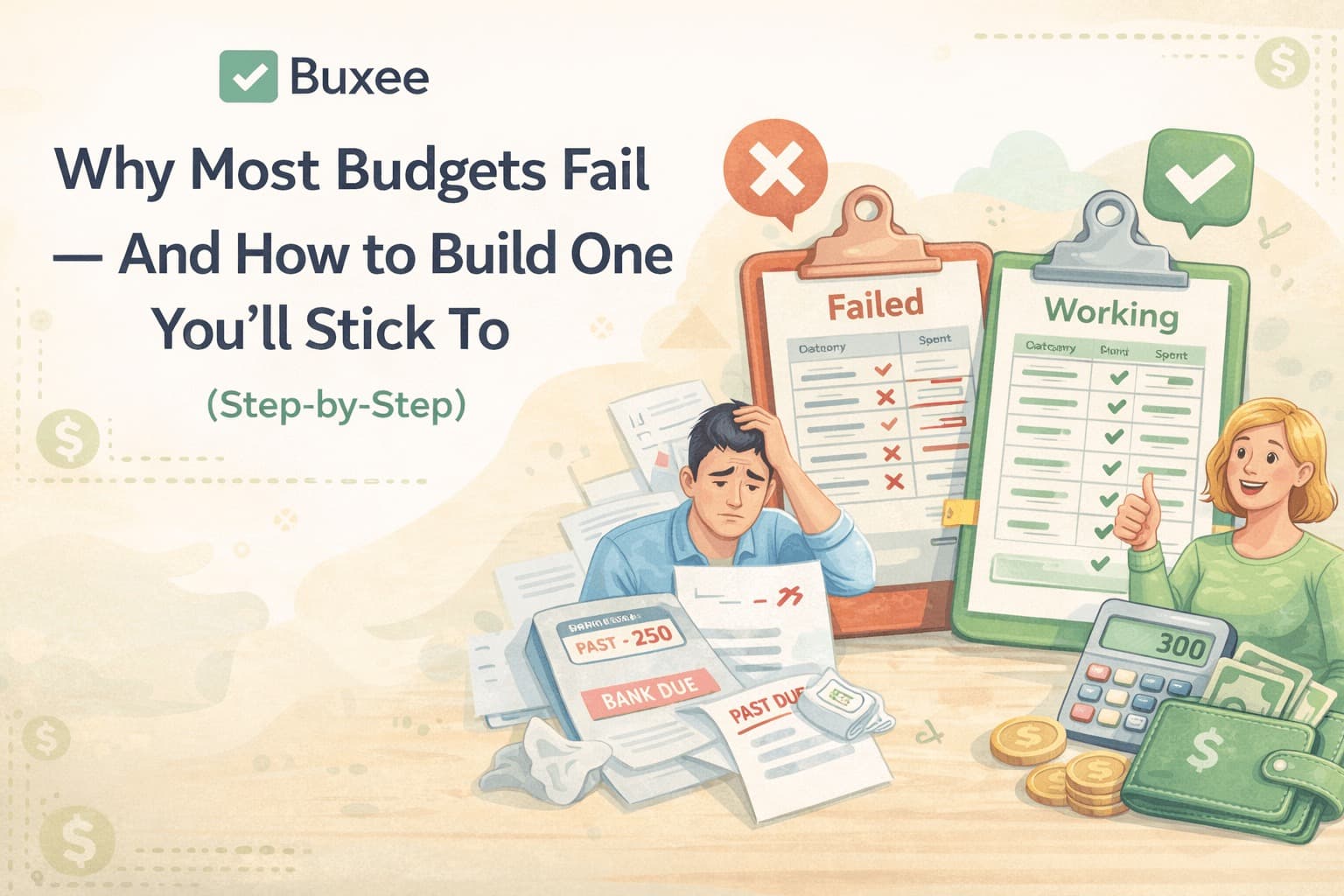
A simple example: failed budget vs working budget
Failed version
- Groceries: €350 (actual spending: €550)
- No buffer
- No fun money
- No plan for surprises
Working version
- Groceries: €550 → €520 next month
- €100 buffer
- €80 fun category
- €50 sinking fund
One survives real life. The other doesn't.
The goal isn't perfection - it's consistency
A budget that's followed at 80% effectiveness beats a perfect one that's abandoned.
You don't need to "start over" every time something goes wrong. You just need to adjust and keep going. Buxee budget planner helps you do just that.
That's how financial progress actually happens.