Zero-Based Budgeting: How to Give Every Pound a Job
Zero-based budgeting means every pound has a job before the month begins. Here's how the method works, with a worked example, pros, cons and pitfalls.
Most budgets tell you what you *should* spend and then quietly hope reality cooperates. Zero-based budgeting takes the opposite approach: before the month begins, you decide where every single pound of your income will go — including the money you save and the debt you repay — until there is nothing left unassigned. Not zero in your bank account. Zero *unallocated*.
It is a deceptively simple idea with a surprising amount of power, and it is also more hands-on than headline rules like the 50/30/20 budget rule. This guide explains where the method comes from, exactly how to run it, what a real month looks like, how to cope with irregular income, and — just as importantly — who it is *not* for.
A quick note before we start: this is general educational information, not personalised financial advice. Your circumstances, debts and goals are your own, so treat the examples as illustrations rather than instructions.
What zero-based budgeting actually means
The core formula is short:
**Income − every assigned amount = £0**
Every pound you expect to receive this month is given a specific job. Rent gets some. Groceries get some. So does your emergency fund, your credit-card overpayment, your car-service fund and even the "fun money" you'll spend guilt-free. You keep assigning until the amount left to assign reaches zero.
The crucial mental shift is that *saving and debt repayment are spending categories too*. In a vague budget, "leftover" money is whatever survives until the next payday — and it rarely survives. In a zero-based budget, there is no leftover, because savings and debt were given their job at the very start. This is why the method pairs so naturally with the idea of turning leftover money into real progress: you remove "leftover" from the equation entirely.
"Balanced to zero" does not mean you spend everything and live on the edge. A budget where £300 is assigned to savings and £150 to a holiday sinking fund is still a zero-based budget — those pounds simply have jobs that involve staying in the bank.
Where the idea came from
Zero-based budgeting did not start in personal finance at all. It originated in **corporate and government budgeting** and is most closely associated with **Peter Pyhrr**, who developed and wrote about the approach at Texas Instruments in the late 1960s and early 1970s. The corporate principle was that each department should justify its entire budget from a "zero base" every cycle, rather than simply inheriting last year's figure plus a few percent. Nothing was assumed; everything had to earn its place.
That justify-every-line philosophy translated neatly to households. In recent decades it was popularised for ordinary budgeters by tools and teachers such as **YNAB**, whose central slogan is "give every dollar a job", and **Dave Ramsey**, who built zero-based budgeting into his step-by-step debt-payoff method. The currency in the slogan is incidental — the principle works just as well in pounds, euros or anything else.
The method, step by step
1. Start from this month's expected take-home income
Use the money you actually expect to receive *this month*, after tax and deductions — not your gross salary and not last month's. If you are paid a steady salary, this is straightforward. If your income wobbles, hold that thought; there's a dedicated section below.
2. List every expense — including the irregular ones
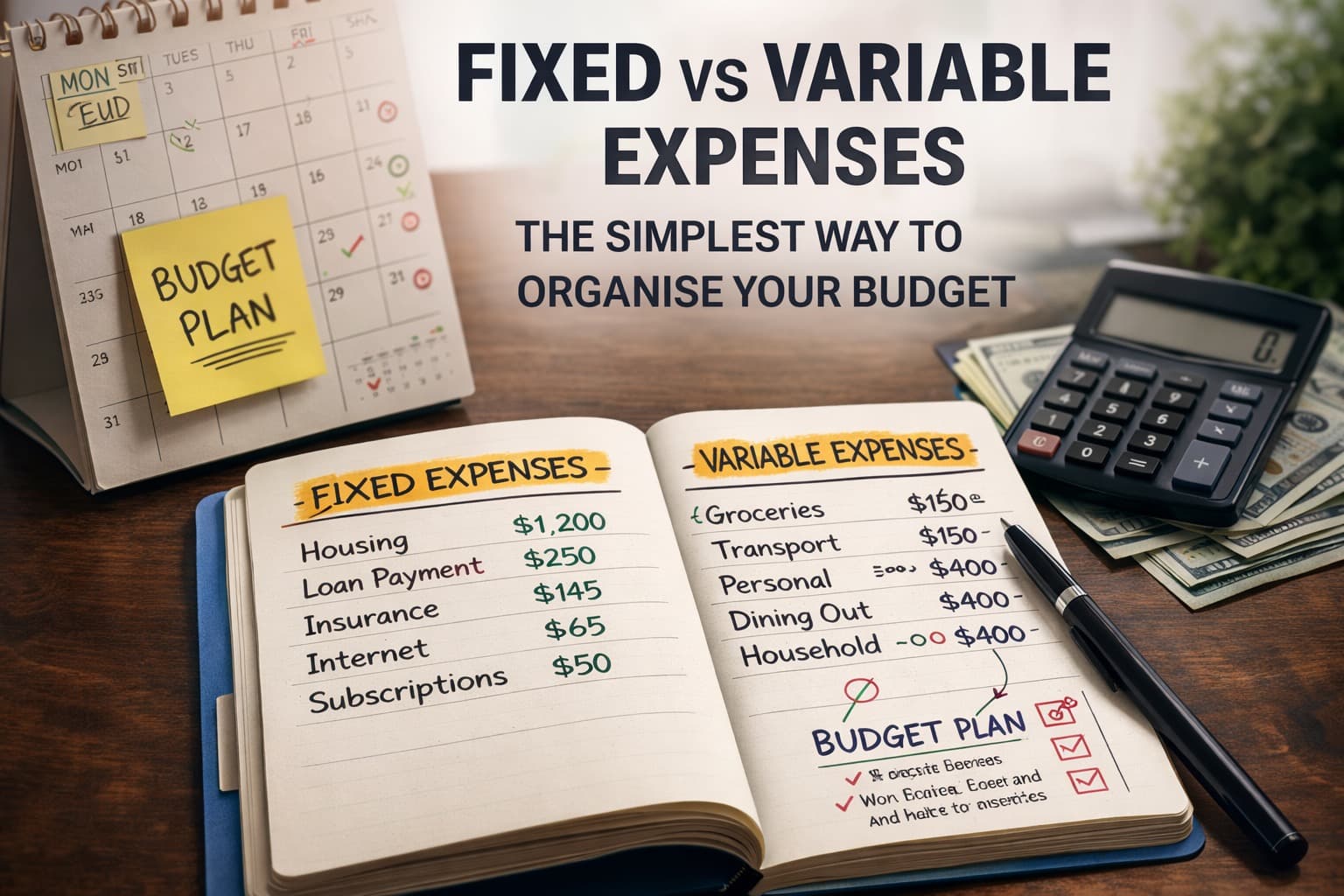
Write down everything. The fixed bills are easy to remember; the irregular costs are what wreck most budgets. Think about the distinction between your fixed and variable expenses, and don't forget the lumpy, occasional ones: car servicing, Christmas, an annual insurance renewal, a boiler service, school trips.
These belong in **sinking funds** — categories where you set aside a little each month for a known future cost. If your car service costs £360 once a year, you assign £30 a month to a "Car maintenance" fund. When the bill lands, the money is already there. Sinking funds are the single biggest reason zero-based budgets survive contact with real life. If you're unsure how to group everything, monthly budget categories explained is a useful starting list.
3. Assign money until the balance is zero
Now distribute your income across those categories in priority order. A sensible sequence is:
- Essentials first — housing, utilities, food, transport, minimum debt payments.
- Then your goals — emergency fund, extra debt repayment, savings, sinking funds.
- Then lifestyle — eating out, hobbies, subscriptions, fun money.
Keep going until "left to assign" reads £0. If you run out of money before the essentials are covered, the budget is telling you something useful *before* the month starts, not after. If you have money spare after everything, don't leave it floating — send it to a goal. Floating money gets spent by accident.
4. Track through the month and adjust
A zero-based budget is a plan, not a prophecy. When you overspend in one category, you don't abandon the budget — you *move money* from another category to cover it. Spent £25 more on groceries? Take it from fun money or dining out. The total stays balanced; only the allocation changes. This monthly habit of tracking expenses without feeling overwhelmed is what turns the plan into reality.
A worked example
Meet a hypothetical budgeter, Priya, with a steady **£2,400** monthly take-home. Here is one month assigned to zero:
| Category | Assigned |
|---|---|
| Rent | £950 |
| Council tax & utilities | £260 |
| Groceries | £320 |
| Transport (fuel + travel) | £140 |
| Mobile & broadband | £55 |
| Minimum debt payments | £90 |
| Emergency fund | £150 |
| Extra debt overpayment | £120 |
| Car maintenance (sinking fund) | £30 |
| Christmas/gifts (sinking fund) | £25 |
| Holiday fund | £80 |
| Subscriptions | £30 |
| Dining out & fun money | £150 |
| **Total assigned** | **£2,400** |
| **Left to assign** | **£0** |
Every pound has a job. Now suppose mid-month Priya's car needs an unexpected £70 repair. She doesn't panic: £30 is already sitting in the car fund, and she covers the remaining £40 by trimming dining out from £100 to £60. The budget still balances. Nothing went on a credit card. That is the method working exactly as intended — the plan absorbed a shock because the shock had somewhere to go.
The same arithmetic works in any currency; only the symbols change.
How to handle variable or irregular income
The most common objection to zero-based budgeting is "but my income isn't the same every month". Freelancers, commission earners, gig workers and people on variable hours can absolutely use it — with one adjustment. Two practical approaches:
- Budget last month's income this month. Don't budget money you hope to earn; budget money you've *already* received. At the end of June you take everything that landed and assign all of it to July. You're always allocating real, banked income, which removes the guesswork entirely.
- Budget to a conservative baseline. Estimate a "lean" income figure you're fairly confident of, build a full zero-based budget on that, and treat anything above it as a bonus to be assigned the moment it arrives — usually to an income-smoothing buffer that tops up thin months.
Either way, a **buffer fund** that holds roughly a month's expenses is what makes irregular income feel calm. You earn into the buffer and spend out of it, so a quiet month no longer means a crisis. If the whole idea of budgeting feels draining, the gentler framing in budgeting without burnout pairs well with this.
The pros
- It is intentional. You decide what your money does, rather than discovering after the fact. Decisions made in advance tend to be calmer and better than decisions made at the till.
- It surfaces leaks. Because every pound must be named, the £11 subscription you forgot and the creeping food-delivery habit have nowhere to hide. In their first zero-based month, many people are surprised by how much small, forgotten spending surfaces — the odd subscription and the incidental purchases that never made it into a plan.
- It is flexible within structure. Moving money between categories mid-month is a feature, not a failure. The framework bends without breaking.
- It accelerates goals. Savings and debt are funded *first*, not last, which is why this method is a backbone of so many debt-payoff plans.
The cons and who it is not for
Zero-based budgeting is not the right tool for everyone, and it's only fair to say so.
- It demands time and attention. A simple percentage rule can be set up in an afternoon and largely left alone. Zero-based budgeting asks for a planning session each month and regular check-ins. If you want a "set and forget" system, the 50/30/20 rule may suit you far better.
- It can feel rigid. Naming every pound is liberating for some people and suffocating for others. If detailed tracking makes you anxious, a looser approach is more sustainable — the best budget is the one you'll actually keep.
- It needs a system for irregular costs. Without sinking funds, the first surprise bill blows the whole plan apart. This is the most common reason zero-based budgets fail in month two.
- It rewards engagement. If you genuinely won't log spending or reconcile categories, the method loses most of its value.
Here is how it compares to the percentage approach:
| Zero-based budgeting | 50/30/20 rule | |
|---|---|---|
| Core idea | Assign every pound to a category | Split income 50% needs / 30% wants / 20% savings |
| Detail level | High — every category named | Low — three broad buckets |
| Time per month | Moderate to high | Minimal |
| Best for | Goal-focused, hands-on planners | Beginners and "keep it simple" types |
| Handles irregular income | Yes, with buffer/sinking funds | Roughly, less precisely |
| Risk | Can feel rigid or fiddly | Can hide overspending inside "wants" |
Neither is "better". They are different tools for different temperaments, and plenty of people start with 50/30/20 and graduate to zero-based once they want more control.
Common pitfalls to avoid
- Forgetting irregular expenses. The classic mistake. If it happens once a year, it still needs a monthly home in a sinking fund.
- Treating the budget as fixed. Reallocating mid-month is the whole point. A budget you refuse to adjust is one you'll abandon.
- Budgeting income you haven't received. Especially with variable pay, allocate money that has actually arrived.
- Being too optimistic on groceries and fun. Under-funding the categories you always overspend just guarantees monthly "failure". Use your real past spending as the starting figure.
- Giving up after one messy month. The first two or three months are calibration. It is easy to give up during this calibration phase, just before the method starts to feel natural — which is the same trap behind why most monthly budgets fail after 30 days.
Doing it with the Buxee budget planner
You can run a zero-based budget on paper or in a spreadsheet, but a tool that keeps a running total saves a lot of arithmetic. With the free Buxee budget planner you start by entering your expected take-home income, then add every category — essentials, savings, debt and sinking funds alike — and watch the "left to assign" figure fall as you allocate. When it reaches zero, your month is balanced. Everything stays in your browser, with no sign-up and no data leaving your device, so you can experiment freely.
If you're new to building a budget from scratch, it's worth reading how to create a monthly budget that actually works alongside this guide — it covers the groundwork that makes zero-based budgeting click.
Give every pound a job, adjust as the month unfolds, and let the running total do the worrying for you. Done consistently, it's one of the most effective ways to make sure your money goes where *you* decide — not where it happens to drift.